DOWNLOAD THE PDF
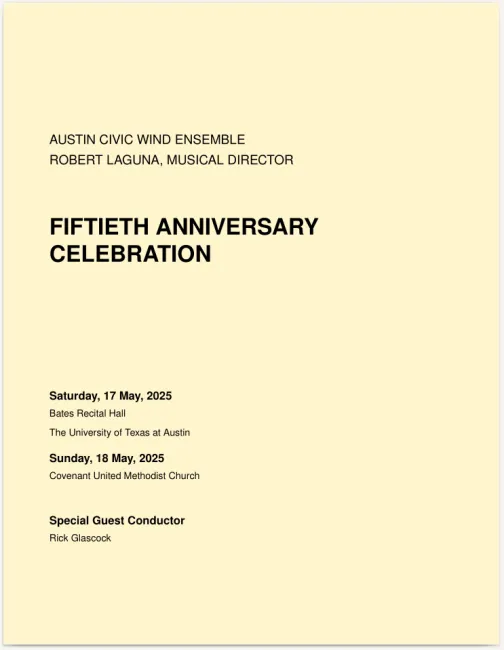
AUSTIN CIVIC WIND ENSEMBLE
ROBERT LAGUNA, MUSICAL DIRECTOR
FIFTIETH ANNIVERSARY CELEBRATION
Saturday, 17 May, 2025
Bates Recital Hall
The University of Texas at Austin
Sunday, 18 May, 2025
Covenant United Methodist Church
Special Guest Conductor
Rick Glascock
AUSTIN CIVIC WIND ENSEMBLE
ACWE’s first concert was performed by a small but plucky group with uneven instrumentation.
Flourish for Wind Band - R. Vaughn Williams
Flourish for Wind Band is a short overture composed by Ralph Vaughan Williams for a 1939 pageant at the Royal Albert Hall. Originally scored for military band, the piece was lost for decades before being rediscovered in 1971. Notable for its accessibility, Flourish for Wind Band followed Vaughan Williams’ great masterworks for band, English Folk Song Suite and Toccata Marziale. The piece holds significance in early 20th-century concert band literature.
Muskrat Ramble - E.Ory, arr. Walter Beeler
Muskrat Ramble is a seminal jazz composition by trombonist Edward “Kid” Ory, first recorded by Louis Armstrong and His Hot Five in Chicago in 1926. It quickly became a staple of the New Orleans jazz repertoire, and later became a jazz standard.
Despite its popularity, Ory initially received no royalties for Muskrat Ramble. In 1965, Country Joe McDonald adapted the tune for his anti-Vietnam War protest song I-Feel-Like-I’m-Fixin’-to-Die Rag, which gained significant attention after being featured at Woodstock. Ory’s daughter, Babette Ory, filed a copyright infringement lawsuit in 2001, alleging that McDonald had used portions of Muskrat Ramble without permission. The case was dismissed due to the statute of limitations, but it highlighted the ongoing relevance of Ory’s composition.
Walter Beeler (1908-1973) was one of the leading brass band educators, arrangers, and conductors in the United States.
The Kadiddlehopper March - Red Skelton, arr. Ron Roullier
The Kadiddlehopper March is a distinctive short selection composed by Red Skelton. Skelton performed for eight U.S. presidents and three Roman Catholic Popes, composed more than 8,000 songs, 64 symphonies, wrote books, and his paintings and drawings remain art collectors' treasures.
In 1969, The Kadiddlehopper March was performed by the Boston Pops Orchestra under the direction of Arthur Fiedler. The march is inspired by Skelton's iconic character, Clem Kadiddlehopper, a bumbling yet endearing country bumpkin.
March Lamar - Clifton Williams
James Clifton Williams (1923-1976) was a composer who began his academic career as Professor of Composition at the University of Texas. Williams also served as a hornist and guest conductor with the symphonies in San Antonio, New Orleans, and Austin.
March Lamar was written in 1964 for the band at Lamar Middle School in Austin, where Williams’ children were students.
Liturgical Music for Band, Op. 33 - Martin Mailman
Composed in 1963 and commissioned by the Greenville County High School Band in Virginia, Liturgical Music for Band is a work in four movements inspired by sections of the Catholic Mass. It has become a landmark in the band repertoire, widely performed and appreciated by generations of students. Each movement reflects a different part of the Mass:
- Introit, a joyful processional with bell-like sounds symbolizing the entrance into worship.
- Kyrie, a somber, prayerful movement based on the phrase “Lord have mercy,” with rhythms reflecting the natural inflection of the word “Kyrie.”
- Gloria, bright and celebratory, mirroring the exclamation “Glory to God in the highest.”
- Alleluia, a vigorous fugue with uplifting brass and woodwind interplay, representing spiritual exaltation and heavenly aspirations.
Mailman's work seeks to musically capture the emotional and spiritual experience of a worship service.
1776, “The Lees of Old Virginia” - Sherman Edwards
1776 is a musical based on the events surrounding the signing of the Declaration of Independence. It premiered on Broadway in 1969, and won three Tony Awards, including Best Musical. Austin Parks and Recreation performed the musical at the Zilker Hillside Theater in the summer of 1975, with ACWE founder Bill Whitworth in the orchestra.
ACWE performed this piece in 1975, leading up to the Bicentennial celebrations of the adoption of the Declaration of Independence.
Instant Concert - Harold L. Walters
Instant Concert by Harold L. Walters has become a staple in band literature. Composed in 1965, this novelty medley features 30 well-known melodies from various genres, including classical themes, folk songs, and popular tunes. Walters cleverly and seamlessly weaves these diverse melodies into a continuous performance lasting just over three minutes.
Instant Concert was ACWE's most-performed non-Christmas piece in the early decades. Over the years ACWE even performed Instant Concert as an encore.
The Grand Marshal - Red Skelton
The Grand Marshal march, composed by Red Skelton, is a ceremonial piece dedicated to the Honorable Everett McKinley Dirksen, the U.S. Senator from Illinois. Senator Dirksen played a pivotal role in the passage of the Civil Rights Act of 1964. Skelton, a longtime admirer of Dirksen's eloquence and leadership, composed this march as a tribute to honor his contributions to American politics.
The march was introduced on “The Red Skelton Hour” on January 16, 1968.
When Do You Say Budweiser? - Steve Karmen
When You Say Budweiser, You’ve Said It All is a memorable advertising jingle composed by Steve Karmen in 1970 for Anheuser-Busch’s Budweiser beer. The phrase "When You Say Budweiser, You’ve Said It All" became synonymous with the brand, reinforcing its position as "The King of Beers."
The Budweiser song played at ACWE's first concert was arranged by UT graduate and Texas band director Steve Curl. It is the only piece that was never played by ACWE again, until now.
The Klaxon - Henry Fillmore
Composed in 1929 for the Cincinnati Automobile Show, The Klaxon by Henry Fillmore is a lively concert march celebrating the iconic Klaxon automobile horns of the early 20th century. At its 1930 premiere, Fillmore debuted the "Klaxophone", a novelty instrument made from twelve car horns powered by a car battery, to replicate the distinctive Klaxon sound.
Castle Gap - Clifton Williams
Castle Gap by Clifton Williams is a concert march composed in 1964, commissioned by the Rankin High School Band in Rankin, Texas. The piece is named after Castle Gap, a historic pass through the Castle Mountains in western Upton County, Texas. This gap has a rich history, having been used by nomadic tribes, Spanish explorers, and pioneers as a crucial crossroad.
Castle Gap Concert March captures the rugged and adventurous spirit of the West Texas landscape.
Tara’s Theme - Max Steiner, arr. Ross Hastings
"Tara's Theme" from Gone with the Wind is a poignant and iconic melody composed by Max Steiner, serving as a musical leitmotif for the O'Hara family's plantation, Tara. This theme is characterized by its sweeping, romantic lines and has become emblematic of the film's grandeur and emotional depth. Arranged for concert band by Ross Hastings, this version of "Tara's Theme" captures the essence of the original composition while adapting it for wind ensemble performance.
Elsa’s Procession to the Cathedral - Richard Wagner
Rick Glascock, guest conductor; Scout Goldsmith, harp
"Elsa's Procession to the Cathedral" is one of the most revered excerpts from Richard Wagner’s 1850 opera Lohengrin, showcasing his mastery of orchestration and emotional drama. In the opera, this music accompanies the solemn and regal moment as Elsa is led to the cathedral for her wedding—a scene filled with both triumph and underlying foreboding.
Lucien Cailliet’s transcription of "Elsa’s Procession to the Cathedral" for concert band is one of the most celebrated symphonic transcriptions in the wind band repertoire. Cailliet, a French-American composer and arranger known for his skill in adapting orchestral music for winds, treated Wagner’s work with great respect and artistic sensitivity.
Disco Inferno - Leroy Green and Ron Kersey, arr. John Higgins
This arrangement of The Trammps' 1976 disco classic, Disco Inferno, originally featured in the Saturday Night Fever soundtrack, captures the song's infectious energy and rhythmic drive.
THE AUSTIN CIVIC WIND ENSEMBLE
The Austin Civic Wind Ensemble is a gathering of adult musicians enjoying the challenge of a high-quality repertoire. The wide range of age and skill level supports our value of inclusion and fosters our mission of using music for lifelong learning, while promoting joy in our community through live performances.
Created in 1975, the Austin Civic Wind Ensemble (ACWE) is a community ensemble formed of both amateur and professional musicians. It is the oldest civic band in Austin. We are a group of volunteer musicians committed to providing musical experiences for our community. You can join at any time. No auditions are required.
ROBERT LAGUNA, MUSICAL DIRECTOR
Robert Laguna is an accomplished performer, arranger, conductor, and practitioner weaving elements of the body-mind-spirit connection into his music and life. Laguna was born in Rio Piedras, Puerto Rico and completed his bachelor's at Southwest Texas State University where he studied music education and went on to teach band in the Texas public school systems for 8 years. He then completed his master's at the Academy of Oriental Medicine at Austin where he studied Asian medicine thereafter going into private practice as an acupuncturist. In 1999, he became the dean of students at his alma mater, AOMA.
Laguna joined the Austin Civic Wind Ensemble in 1998. Later that year, he became the semi-conductor for the group, assisting Rick Glascock from 1997-2003 and Paul Crockett from 2003-2005. In 2005, he was selected as Conductor of the Austin Civic Wind Ensemble. While a member of ACWE, he joined other civic music groups including the Austin Philharmonic Orchestra and Cori Spezzatti. He also joined and formed performing ensembles like the Frontier Brass, Austin Brass Band, and the Brandished Brass.
RICK GLASCOCK, GUEST CONDUCTOR
Originally from San Francisco, Rick Glascock received his Masters in Music in percussion performance from SUNY Stony Brook. After five years as Principal Percussionist with the Filarmónica de Jalisco in Guadalajara, Mexico, he and his family moved to Austin where he worked as a band director in Pflugerville and Austin as well as being an active jazz vibraphonist. From 1997 to 2003 he proudly directed the Austin Civic Wind Ensemble with the assistance of Robert Laguna.
In 2008 Rick and his family moved to Asia with the opportunity to run the middle school band and jazz program at the Shanghai American School. In 2015 he conducted the Association for Music in International School’s Middle School Honor Band in Chennai, India. Now back in Austin, he enjoys playing drums and singing with several groups around town.
PERFORMERS
Flute
- Caroline Acuña
- Sherry Aten
- Kathleen Brotherton
- William Delgado
- Shawn Dennison
- Melissa Dowdy
- Tina Renee D'Souza
- Aldo Esparza
- Mary Gasal
- Kathie Goldsmith
- Ashley Hilton
- Karina Jakobeit
- Joanna Lucero
- Susan McClure
- Alyssa McKnight
- Kara Myers
- Liz Payne
- Caitlyn Schroeder-Willuhn
- Jack Si
- Debbie Spurlock
- Andrea Torres
Oboe
- Robin DeWeese
- Nina Siegel
Eb Clarinet
- Karen Delk
Clarinet
- Jay Berry
- Luis Castillo
- Kevone Hospedales
- Jessica Johnson
- Caitlin Keegan
- Danny Kostelancik
- Sara Ramasastry
- Janet Rice
- Alicia Rusthoven
- Taylor Queitsch
- Caroline Soper
- Meagan Weaver
Alto Clarinet
- Ellen Knapton
Bass Clarinet
- Michael Bonagurio
- Aaron Cano
- Laura Larsen
Bassoon
- Melanie Wedige
Alto Saxophone
- Kristin Blake
- Allison Cavazos
- Debbie Dalke
- Mariana Gama
- Mariel Garcia
- Michelle Lobermeier
- Sharon Melville
- Chris O'Connor
- Stephanie Pektas
- Laura Scholten
- Eric White
Tenor Saxophone
- Shayne Calhoun
- Chyna Christensen
- Thomas Ibbetson
Baritone Saxophone
- Rollie Cole
- Kayla Grissett
Trumpet
- Jennifer Clarke
- Jake Clement
- David Dalke
- Marcy Graham
- James Hatheway
- Amber Nepodal
- Julio Sanchez
- Kevin Slaughter
- Duke Tanner
- Hannah Wilson
- Rob Wilson
Horn
- Clint Colisch
- Kalyn Cordova
- Tyler Darsey
- Marc Frazier
- Melissa Kunkel
- Nancy Middlebrook
- Chris Willuhn
Trombone
- Rene Barron
- Warren Gill
- Chris Glenn
- Giuseppe Maccagnan
- Rob Muñoz
- Bob Roeder
Euphonium
- James Barnard
- Seth Butler
- Jack Robertson
- Danny Tosiano
Tuba
- Michael Bell
- Rick Colvin
- David Dawson
- Frank Salinas
Percussion
- Josh Barber
- Stephen Jones
- Terra Lindgren
- Alyssa McKnight
- Seth Neuman
- Ronald Reed
- Bob Russin
Harp
- Scout Goldsmith
THANK YOU FOR YOUR SUPPORT
ACWE is an 501(c)3 non‑profit corporation. Our corporate underwriters and individual sponsors play an important role in our ability to bring free public performances of great concert band literature to the Austin area. Visit acwe.org/sponsor to learn more.
We are proud to recognize Central Market and Westbank String Shop for their support during our 50th anniversary season.
ACWE would like to thank Clif Maloney for his generous donation to the Austin Civic Wind Ensemble in memory of his beloved wife, Karen Maloney.
“The band rehearsed on the second floor of the old, unairconditioned building that housed the Blanco Street Firehouse. Members usually left the large windows open, which annoyed some neighbors.